


What Do I Consider When Buying A Caliper?
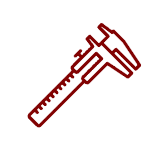
Choosing the right caliper requires careful consideration and numerous factors of measurement needs, accuracy, resolution, range, material, display type, data output options, and more. Selecting the right caliper that will fit your application will ensure reliable, consistent, and precise measurements all while avoiding unnecessary costs or frustrations.
If you are planning on buying a caliper, read this guide to make sure you make the right decisions. There are numerous factors that will guide your decision into determining what kind of caliper you will buy.
This article delves into the considerations you should make before selecting a caliper.
In This Article:
- Caliper Type
- Accuracy
- Resolution
- Range
- Material and Construction
- Environment Conditions
- Display
- Data Output Options
- Brand Reputation
- Price
- What To Consider When Buying a Caliper FAQs
This is the ninth article in our series, The Definitive Guide to Calipers.
If you missed the last part of the series: Caliper Features and Accessories, check it out now!
Selecting The Right Caliper Type
The type of measurement you are inspecting is the most critical feature to consider when selecting a caliper. Simply put, if the caliper you are using doesn’t have the ability to measure the features of the item you are inspecting, the caliper becomes nothing more than a fancy paperweight. Make sure you determine the type of measurement required such as:
- Outside Measurement
- Inside Measurement
- Depth Measurement
- Step Measurement
As mentioned previously, different types of calipers are designed for these different types of measurements. Make sure that you are selecting the appropriate type before considering anything else.
Selecting The Right Caliper Accuracy
Accuracy is a close second of the most critical features to consider when selecting a caliper. The accuracy of a caliper determines how close the measurement is to the actual dimension of the object being measured. Due to numerous factors, there has never been, nor will there ever be, a perfectly precise measurement.
Because of this, the caliper itself is given an allowance on its measurement reading to state that the measurement is equal to X, but it could be within the range of ± Y. It is usually expressed as an allowable deviation of plus or minus (±) a tiny portion of whatever measurement unit you are using, such as ±0.001 inches (or ±0.025 mm).
Selecting The Right Caliper Resolution
As opposed to accuracy, resolution, on the other hand, refers to the smallest incremental change that can be measured by the caliper. It is usually expressed in fractions of an inch or in millimeters. For example, a caliper with a resolution of 0.01 mm can measure changes in distance as small as 0.01 mm.
Most digital calipers will have resolutions of 0.005 in, but there are many that will even go further with resolutions up to or even exceeding 0.00005 in.
All of that is great, but how do you actually know what resolution to select for the job?
This is where the 10:1 rule comes into play. Essentially, the 10:1 rule state that the caliper you are using should have 10x higher resolution and accuracy than the measurement on the part you are taking. For example if the part you are measuring has an acceptable tolerance of ±0.01″ then the caliper should have a resolution and accuracy of at least ±0.001″. There are some strong opinions out there whether or not 10:1 is overkill, but in general, this is the easiest rule to follow.
All of this is to prevent you from accepting bad parts and rejecting good parts. If the caliper you are using carries the same (or lesser) resolution as the acceptable tolerance, you will have no way of ensuring this is not the case.
If you don’t know the acceptable tolerance of the measurement you are taking, odds are it is not critical. In that instance, just about any caliper will do.
Selecting A Caliper Size (Range)
Caliper sizes are typically defined by the measurement range they are capable of handling. All functions of a caliper (outside diameter, inside diameter, depth, and step) all utilize the same scale and range, so the range stated for a specific caliper would be applicable to all aspects of that caliper. The most common sizes of a caliper are:
- 0-6 inches (or 0-150 mm)
- 0-8 inches (or 0-200 mm)
- 0-12 inches (or 0-300 mm)
- 0-24 inches (or 0-600 mm)
Since most dimensions or manufactured parts are under 6 inches, the most common size is 0-6 inches (or 0-150 mm). This size is a perfect balance of handling a wide range of applications while not being too large to handle and use on a regular basis.
There technically is no upper limit to the range of a caliper, however practically comes into play. The larger the caliper the more difficult it will be to use, the less accurate it will be, the heavier it will be, and storing it will be much more difficult. The largest sizes of calipers can vary depending on the specific type of caliper and the application it is being used for and are far less common. Some large-scale calipers can measure up to several feet (of even dozens of feet) in length. These types of calipers are typically used in industrial settings such as in the manufacturing of large machinery or structures.
When selecting the appropriate size of a caliper, you should consider the following factors:
- The Range of Measurements You Need to Take: Choose a caliper that has a measurement range that will cover the majority of the measurements you need to take.
- The Precision You Require: If you need to take precise measurements, you may need a caliper with a smaller measurement rang but with a higher level of precision. The larger the caliper, the less precise it typically will be.
- The Type of Work You Will be Doing: If you will be measuring large or bulky objects, you may need a larger caliper than if you are measuring small or delicate objects.
- The Space You Have Available: Consider the space you have available to store and transport the caliper. Obviously the larger the caliper the more space it will take up.
- The Budget You Have: In general, the larger the caliper, the higher it will cost.
Selecting The Right Caliper Material And Construction
Calipers can be made from a variety of materials, each with its own unique properties and benefits and can have a very large impact on both the quality of the tool and the accuracy of your measurement. The most common types of materials that calipers are made from are:
- Stainless Steel: Stainless steel is a common material used in the construction of calipers. It is strong, durable, and resists corrosion, making it ideal for using it in harsh environments.
- Carbon Fiber: Carbon fiber is another material that is becoming increasingly popular due to its high strength to-weight ratio and resistance to temperature changes. However, this type of material requires more maintenance if used more frequently.
- Aluminum: Aluminum is lightweight and has good resistance to corrosion, but it is not as durable as stainless steel.
- Plastic: Plastic calipers are lightweight and inexpensive, but they are by far the least accurate material to measure with.
The construction of the caliper is also an important consideration. A caliper with a solid construction and sturdy jaws will provide more accurate readings than a caliper with flimsy construction.
The frame of the caliper should be sturdy and made of a high-quality material such as stainless steel or carbon fiber. The frame should also be designed to resist torsion and bending forces to ensure that the jaws remain stable during use.
The jaws of the caliper are responsible for making contact with the object being measured. The measuring surfaces of the jaws should be flat, aligned, and parallel to ensure accurate measurements. The jaws should also be designed to minimize play or movement during use, which can be lead to inaccurate readings.
The slide of the caliper should move smoothly and without binding, ensuring that the jaws can be positioned accurately. The slide should also be designed to resister wear and tear, ensuring that the caliper remains accurate over time.
The locking mechanism of the caliper is another important aspect of its construction. The locking mechanism should be easy to use and provide a secure hold on the jaws to prevent movement during measurement.
Selecting The Right Caliper For The Environment Conditions
The environment the caliper will be used in is also a very critical component of selecting the right caliper for the job.
The first thing to consider is the conditions of the workplace. If the job requires exposure to dust, water, or other harsh conditions (such as out on the shop floor, where calipers are most commonly used), it is essential to select a caliper with an appropriate IP (Ingress Protection) rating. The IP rating is a standard measure of the degree of protection that a caliper provides against dust, water, and other containment. The rating consists of two digits: the first digit indicated the level of protection against solid objects (such as dust), while the second digit indicated the level of protection against liquids (such as water).
For example, a caliper with an IP rating of IP67 provides complete protection against dust and can withstand being submerged in water for up to 30 minutes. Calipers with an IP67 are used more on the shop floor. On the other hand, a caliper with an IP rating of IP54 provides limited protection against dust and water spray. Calipers with an IP54 are used more for a general setting.
If the job requires use in a dusty or wet environment, it is important to select a caliper with a high IP rating such as IP67. If the job requires use in a clean, dry environment, a lower IP rating such as IP54 may be sufficient.
The next thing to consider is the type of work that is being performed itself. For example, if you are completing very psychical, rough work, a much more sturdy and/or cheaper caliper would be necessary than one used in a quality lab. This is simply due to the fact that the caliper is much more likely to be abused in that scenario. However, inside a quality lab, where accuracy is far more critical than durability, a more expensive and accurate caliper would likely be the right selection.
In general we live by the rule: “If your guys are going to break it anyway, have them break a cheap one.”
Selecting The Right Caliper Display Type
Ultimately, the choice of caliper display type will depend on the preferences of the user and level of the precision needed.
The preferences of the user likely matter the most in this instance. If the user simply does not know how to use a verier or dial caliper, it does not matter how accurate or well-suited the display type is to the job. They are setting themselves up for failure, just by not knowing how to use the caliper properly.
Digital calipers are certainly the easiest caliper to read and therefore is a practical solution for the widest array of users and most applications. Since it provides an actual readout of the measurement, they provide a clear and precise measurement reading. Dial calipers, on the other hand, have a dial display, which may not be as easy to read as digital displays, but they are easier to read from different angles compared to a vernier caliper.
If the job requires a high degree of accuracy and precision, a digital caliper may be the best choice, as it generally provides a more accurate measurement. However, if the job involves working in tight spaces or difficult-to-reach areas, a dial caliper may be more suitable as it can be read from different angles without needing to adjust the viewing angle.
In addition to the display type, it is also important to consider the size of the display, the brightness, and any additional features such as a backlight. All of these factors can affect the readability of the measurement, particularly in low lighting conditions.
Selecting The Right Caliper Data Output Options
Most calipers are a simple, “you get what you get” readout – meaning that the data is only shown on the caliper itself and not passed anywhere.
However, as technology continues to advance many calipers are now being manufactured with SPC (Statistical Process Control) data collection options. SPC is a feature that allows for the collection of measurement data and its analysis for quality control and process improvement. Some calipers have the ability to connect to a computer for data collection and analysis. This allows for much more rapid and accurate collection of the data itself and allows for it to be easily transferred into other software. There are two primary types of SPC systems:
- Wired SPC: Wired systems use a physical cable to transmit data from the instrument to the data collection system. This type of system is often preferred in environments where wireless communication is not reliable or secure, or where large amounts of data are being transmitted.
- Wireless SPC: Wireless systems, on the other hand, use radio frequency (RF) communication, also know as Bluetooth in modern terms, to transmit data from the instrument to the data collection system. This type of system is often preferred in environments where mobility is important or where a large number of instruments are being used. This allows for the usage of the tool far away from a computer – potentially right on the production line.
What Are The Best Caliper Brands?
Selecting a caliper from a reputable brand can give you a peace of mind that you are getting a reliable and accurate measuring tool that will provide consistent performance over time. It may cost more initially, but the investment can pay off in the long run with improved accuracy and durability. Doing so can help ensure that you are getting a reliable and accurate product.
A well-established brand with a good reputation is more likely to have invested in research and development to ensure that their calipers are manufactured to high standards. They are also more likely to use high-quality materials and employ skilled craftsmen to produce their products.
Reputable brands are also more likely to provide customer support and after-sales service. This can be especially important if you have any issues with your caliper or require technical support.
It is also worth considering that reputable brands may have a wider range of calipers available, with different sizes, features, and specification to suit different applications. This can be useful if you have specific requirements or your caliper, such as needing a larger jaw size or digital readout.
There are many reputable brands in the market that manufacture high-quality calipers. If you would like to use the percentage of calipers we see through our lab for calibration as a proxy for their popularity and reputation, below is a list of each, in order of how frequently we see them.
| Brands | Percent of Calipers |
|---|---|
 | 60% |
 | 7% |
 | 7% |
 | 5% |
 | 4% |
- Mitutoyo: A Japanese company that is considered to be the leading manufacturer of precision measuring tools, including calipers.
- Fowler: An American company that specializes in metrology and produces a range of measuring tools, including calipers.
- Insize: Insize is a leading manufacturer of measuring instruments, including calipers. The company produces high-quality and accurate calipers that are widely used in a variety of industries.
- Starrett: An American company that has been producing measuring tools for over 140 years. They offer a wide range of calipers, including digital and dial calipers.
- Brown & Sharpe: An American company with over 175 years of experience in producing precision measuring tools, including calipers.
Selecting The Right Caliper For Your Budget
The cost of a caliper varies depending on the features and quality of the tool. In a perfect world, you could get the biggest caliper with all the bells and whistles for the same price as a basic one, but of course, we don’t live in one of those. A basic vernier caliper can be purchased for as little as $10, while a high-end caliper can cost up to $400 or more.
The cost of a caliper typically increases with the complexity of the measurement tasks it can perform, the accuracy of its measurements, and the durability of its construction. For example, a digital caliper with advanced measurement features such as data output, automatic shut-off, or IP67 dust and water protection will likely be more expensive than a basic vernier caliper.
Is it important to balance your budget and the features you determined above that you need for your specific applications. In other words, be honest.
Don’t skimp and pinch a penny – if you need to take more precise measurement or need additional measurement features, a higher-end caliper may be necessary. In general, the old saying, “You get what you pay for” rings true here.
However, don’t overdo it either. If you are only measuring basic dimensions, a simple vernier caliper may suffice. It is important to understand that overkill in measurement can be just as detrimental to the outcome of a project as ignoring the science all together. If you simply need a caliper to do one spot check on something that only you will ever use, you simply don’t need a $400 caliper with all the bells and whistles to do the job.
Conclusion
Choosing the right caliper comes down to understanding your specific needs whether it is measurement types and accuracy requirements to durability, ease of use, and budget. Whether you’re taking basic measurements or inspecting parts with tight tolerances, investing in the right caliper ensures accurate, reliable, and efficient results. Taking the time to evaluate your options now will pay off in accuracy and performance for years to come.
What To Consider When Buying A Caliper FAQs
Q1. What should I prioritize when buying a caliper?
The caliper type should always be the starting point. If the caliper cannot physically measure the feature you’re inspecting, accuracy, resolution, and price become irrelevant.
Q2. Should I choose durability or accuracy when buying a caliper?
That depends on the application. In rough, physical environments, a durable caliper may matter more than accuracy. In a quality lab, you will more than likely prioritize accuracy.
Q3. Is it better to be one high-end caliper or multiple lower-cost calipers?
That answer depends on how the tool is being used. A high-end caliper will make more sense for controlled, critical measurements, while lower-cost tools may be more practical for rough or shared-use environments.
Q4. Does display type impact measurement results?
Indirectly, yes. A display that is difficult for the user to read or interpret increases the likelihood of measurement error, even if the caliper itself is highly accurate.
The Definitive Guide To Calipers
What’s Next: How Do You Use A Caliper?
Now that you have successfully selected your caliper, all that is left is to learn how to use and care for it.
In the next section, we will dive into how to use calipers properly for the best results. Let’s get started and head to Section 10: How To Use A Caliper.
ISO/IEC 17025 Accredited Caliper Calibration
Fox Valley Metrology offers precise caliper calibration for any make or model. Our ISO/IEC 17025 accreditation guarantees testing to the highest industry standards. We offer fast, reliable in-lab or onsite calibration services to fit your needs and schedule.
- ✓ ISO/IEC 17025 accredited calibration vendor
- ✓ Broadest calibration scope in the industry
- ✓ 3-5 day turnaround time in-lab calibrations
- ✓ Pickup and delivery service options
- ✓ Onsite calibration available