


How Do I Calibrate A Caliper?
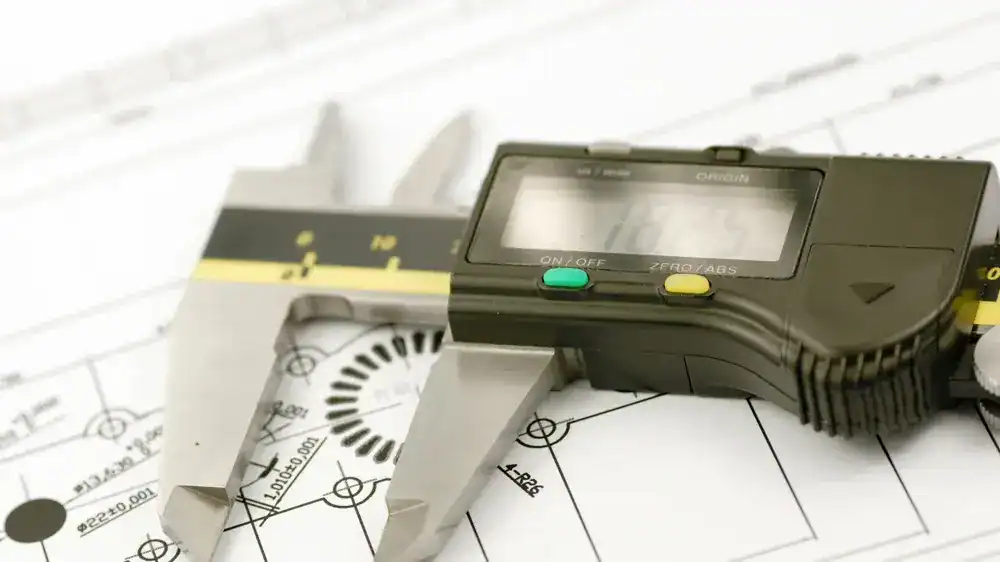
To calibrate a caliper, it must be compared against known, traceable standards in a controlled environment. The process involves cleaning and inspecting the caliper, verifying and adjusting the zero point, and measuring certified gage blocks or standards at multiple points across the measuring range. Results are compared to acceptable tolerances, adjustments are made if needed, and all findings are documented with calibration records and labels to ensure accuracy, traceability, and compliance.
Calipers are essential precision measurement tools, but like any instrument, their accuracy can drift over time due to wear, environmental changes, and frequent use. Regular calibration is crucial to ensure that your caliper continues to deliver reliable, traceable, and repeatable measurements.
Proper calibration goes beyond simply checking readings. It involves confirming accuracy against traceable standards in a controlled environment, using qualified technicians and the right reference gages. Even small shifts in temperature, humidity, or static can impact results, so preparing both the caliper and its environment is key to maintaining compliance and confidence in your measurements.
Accurate calibration also relies on thorough documentation and clear reporting to prove compliance, maintain traceability, and identify when a tool no longer meets tolerance. Properly labeled and managed equipment ensures your tools are used, maintained, and recalibrated as needed. Doing all of this will preserve the foundation of quality and precision across every stage of your manufacturing or inspection process.
In this article, we’ll walk through everything you need to know about caliper calibration. We will go over understanding when and why to calibrate your caliper, to preparing your environment for calibration, selecting the right standards, and properly documenting your results.
In This Article:
- Why Calipers Need to be Calibrated
- How Often to Calibrate a Caliper
- When to Calibrate a Caliper
- Caliper Calibration Preparation and Environment
- Tools and Standards for Caliper Calibration
- Determining the Number of Test Points
- How to Calibrate a Caliper
- Managing Calibration Records and Labels
- Caliper Calibration FAQs
This is the thirteenth article in our series, The Definitive Guide to Calipers.
If you missed the last part of the series: Care and Maintenance of Calipers, check it out now!
Why Calipers Need To Be Calibrated
Calibrating a caliper is important for ensuring accurate measurements. Over time, the moving parts of a caliper may become worn or misaligned, resulting in inaccurate measurements. Additionally, environmental factors such as temperature and humidity can also affect the accuracy of a caliper. Calibrating a caliper ensures that it is measuring correctly and within the manufacturer’s specified tolerances.
Regular calibration also helps to identify any issues with the caliper before they become major problems, such as worn or damaged jaws, or a loose or wobbly slide. If these issues are not addressed, they can lead to inaccurate measurements and ultimately affect the quality of the final product.
Calibrating a caliper is also important for compliance with industry standards, such as ISO 9001, which require regular calibration of measuring instruments to ensure that measurements are accurate and traceable.
In summary, calibrating a caliper is a necessary step in maintaining accurate measurements, identifying potential issues, and ensuring compliance with industry standards.
How Often To Calibrate A Caliper
The frequency at which a caliper should be calibrated depends on several factors, including the usage and the environment it’s used in. It’s generally recommended to calibrate a caliper at least once a year, or more often if it’s used frequently or in a harsh environment.
For example, if a caliper is used in a manufacturing environment, where it is being used to measure parts that will be used in critical applications, it should be calibrated more frequently. In some cases, it may be calibrated after every use, every shift, or every week.
If a caliper is used in a laboratory setting, where measurements are less critical, it may be calibrated less frequently such as once a year. It’s also worth mentioning that some organizations or agencies such as ISO 9001, require regular calibration of measuring instruments to ensure that measurements are accurate and traceable.
In summary, the frequency at which a caliper should be calibrated depends on the usage and environment it’s used in. It’s recommended to calibrate a caliper at least once a year, or more often if it’s used frequently or in a harsh environment, and compliance with industry standards.
When To Calibrate A Caliper
There are several circumstances when it is recommended to caliper your caliper:
When the Caliper is New
A new caliper should be calibrated before it is used for the first time to ensure that it is measuring correctly and within the manufacturer’s specified tolerances.
Before and After a Period of Prolonged Storage
If a caliper is not going to be used for an extended period of time (1+ year(s)), it should be calibrated before being put into storage and again after being taken out of storage to ensure that it is still measuring correctly.
After a Period of Heavy Usage
If a caliper is being used frequently, it may require more frequent calibration to ensure that it is still measuring correctly.
When There is a Change in the Environment
Environmental factors such as temperature and humidity can affect the accuracy of a caliper, so it should be calibrated if it is being used in a different environment than it is normally used in.
Signs of Wear and Tear
If you notice signs of wear and tear on your caliper such as bent or damaged jaws or a loose or wobbly slide, it should be calibrated to ensure that it is still measuring correctly.
Regularly as per Standards
Some organizations or agencies such as ISO 9001, require regular calibration of measuring instruments to ensure that measurements are accurate and traceable.
Caliper Calibration Preparation And Environment
When you are ready to calibrate your caliper, the accuracy of your calibration doesn’t depend on the skill of the calibration technician or the quality of the equipment you have, it heavily depends on the preparation and the environment in which the calibration takes place in. Small changes in temperature, humidity or even static can cause errors during the calibration which will cause you to have an inaccurate caliper which will ripple through your quality system. It is important to prepare both your calipers and the environment you will be doing the calibration in to ensure compliant results.
Preparing Your Caliper for Calibration
Cleaning Your Caliper
Make sure the calipers are clean and free of debris. Wipe down the jaws, beam and depth rod to remove any dirt, dust, or grime. Even the smallest containment can affect the accuracy of the calibration.
Checking the Caliper for Damage
Inspect the calipers for any signs of damage or wear such as bent or broken jaws, chips, or any other wear. If any damage is found, it should be repaired before calibration or the calipers should be replaced all together if the damage is severe.
Record the Current Readings
Before calibration, take measurements with the caliper and document the baseline readings. These readings will serve as a reference point for the calibrated measurements.
Gather Necessary Equipment
Make sure you have all the necessary equipment and standards, such as master gages or calibration blocks, that will be required for the calibration process. Ensure that your master gages and calibration blocks are in good condition.
Review the Procedures
Review the calibration procedures and ensure that you understand the process and are familiar with the equipment and the quality standards that are to be met.
Schedule With a Reputable Laboratory
If you are outsourcing your caliper to have it calibrated, choose a reputable, accredited laboratory or professional service provider that can perform the calibration for you, like Fox Valley Metrology.
Note that these steps may vary depending on the specific calibration process and the laboratory you choose to work with. It is always best to check with the specific laboratory you choose for their requirements and procedures.
Caliper Calibration Environment
The environment you are calibrating your caliper in is just as important as the equipment you are using to calibrate the tool. All physical objects can grow or shrink with changes in certain environmental factors. For example, steel grows 0.000013 inches for every 1 degree Celsius. This may not seem like much, but when measuring highly accurate devices, this could be the cause of your uncertainty budget growing to unusable levels. Because of this, it is imperative to control the environment in which you are about to calibrate, as much as possible.
There are key environmental conditions that should be in place for caliper calibration to ensure the accuracy and repeatability of the measurements:
Temperature
The temperature should be controlled and maintained within a narrow range, typically between 20 and 25 degrees Celsius (68 to 77 degrees Fahrenheit). The industry standard is 68 degrees Fahrenheit. Any deviations, even by a single degree, can alter dimensions by micro-inches which can create significant uncertainty.
Humidity
The humidity should be controlled and maintained within a narrow range, typically between 40 and 60% relative humidity.
Lighting
Adequate lighting should be provided to ensure that the technician can clearly see the caliper and the standards.
Cleanliness
The area should be clean and free from dust and debris, as this can affect the accuracy of the calibration.
Stable Surface
The surface on which the caliper and standards are placed should be stable, level, and vibration-free.
Air Flow
Air flow should be minimized as much as possible to avoid drafts, which can affect the measurement results.
Magnetic Fields
The calibration should be done in an area with minimal magnetic fields, as they can affect the readings of the caliper.
Static Electricity
The calibration should be done in an area with minimal static electricity, as it can affect the measurement results.
It’s important to note that some specific calibration may require different environmental conditions. It’s always best to check with the specific laboratory or service provider to ensure compliance with their requirements.
Soaking and Stabilization Time
Simply bringing a caliper in off the shop floor and immediately calibrating it in the more controlled environment of a quality lab may not be good enough, depending upon the temperature variance of the shop floor and the lab. Because of this, allowing a caliper to “soak” in the environment is strongly recommended.
The length of time a caliper should “soak” in an environment before being calibrated, also called “stabilization time”, depends on the specific calibration process and the severity of the environmental shift between its normal environment and the lab environment.
However, in general, it is recommended to allow at least 30 minutes to 1 hour to allow it to reach thermal and humidity equilibrium.
Tools And Standards For Caliper Calibration
Having the right tools and standards is just as important as controlling the environment when you are looking to calibrate your caliper. Without any proper reference gages, software, or qualified technicians, your calibration can produce unreliable results, even if you have the most environmentally stable lab. The goal of calibrating your caliper isn’t just to check your caliper to see if it is getting the correct readings, but it is to confirm accuracy against traceable standards and document reliability through an accredited process.
What You Need to Calibrate a Caliper
To calibrate a caliper, you will need the following:
Caliper
The caliper that you are needing to calibrate should be in good working condition and free from damage.
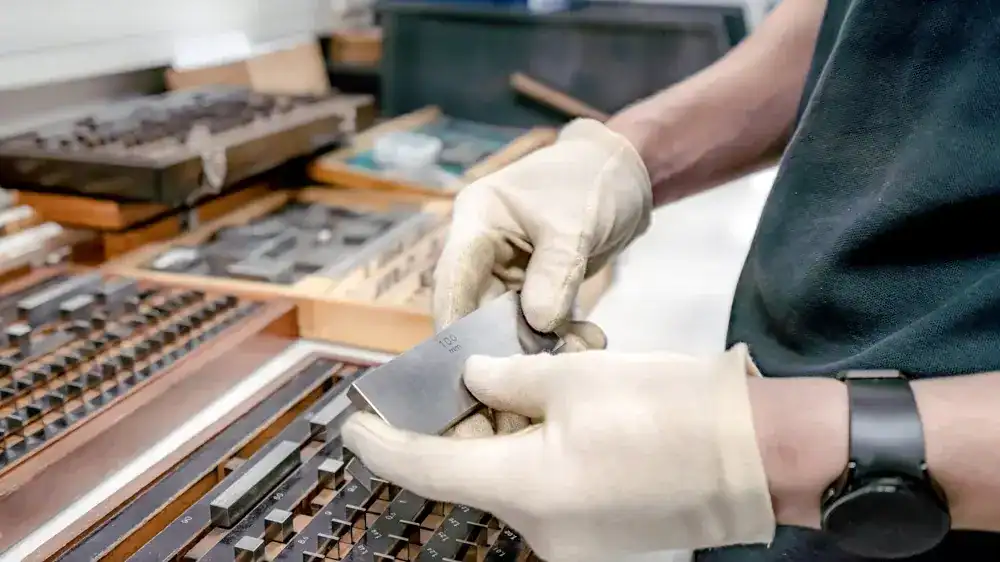
Master Gages or Calibration Blocks
Master gages and calibration blocks are precision measurement standards that are used to check the accuracy of the caliper. These tools come in different sizes and shapes, and are typically made of steel, ceramic, or other hard materials.
Measuring Device
A high-precision measuring device, such as a micrometer, to measure and validate the master gages or calibration blocks.
Environmental Controls
A stable environment with controlled temperature and humidity to minimize the effects of environmental factors on the calibration process.
Cleaning Materials
Cleaning materials such as alcohol, cotton swabs, or lens tissue to clean the caliper and master gages before calibration.
Calibration Software and/or Procedure
The laboratory or service provider you choose to work with may have specific software and procedures for calibration, ensuring you have access to them.
Trained and Qualified Technician
A trained or qualified technician is needed to perform the calibration and to also interpret the results and make any adjustments if necessary.
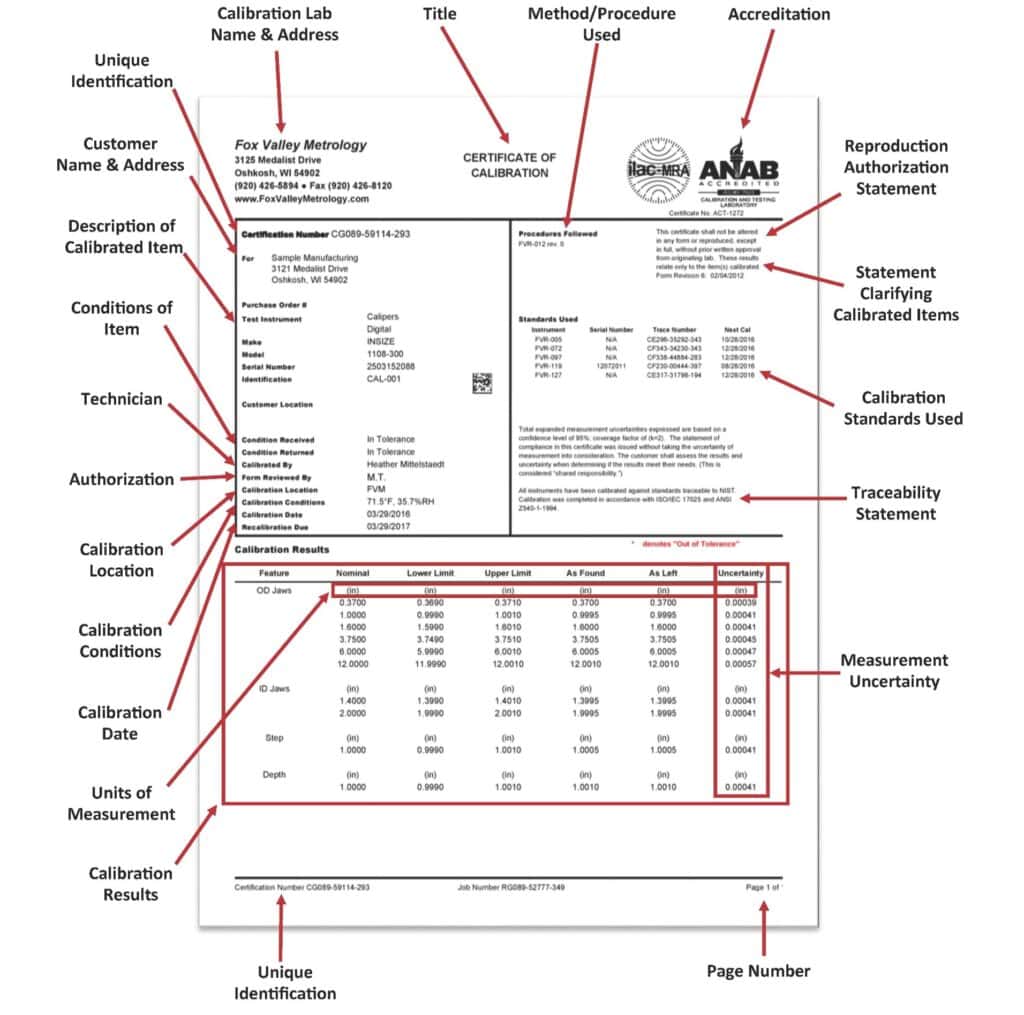
Calibration Certificate
A certificate of calibration is a certified document and is usually provided after the process and show the results of the calibration and the date of the next calibration.
Click Here to View What Should Be On Your Calibration Certificate
Calibration Label
A clear label on the caliper itself marking the calibration status, including the last and next calibration dates.
Note that these requirements may vary depending on the specific calibration process and the laboratory or service provider you choose to work with. It is best to check with them for their specific requirements.
How to Determine the Acceptable Tolerance of a Caliper
Tolerance is defined as how much deviation is acceptable between the caliper’s reading and the true standard that it is being compared to. Setting the correct tolerance will ensure your tool can perform as intended without introducing measurement risk. To determine the tolerance of your caliper for calibration, you can use the following steps:
Reviewing the Manufacturer’s Specifications
Check the manufacturer’s specifications for the brand of caliper you have and see if they provide any information on the tolerance. This information typically can be found in the user manual or on the manufacturer’s website.
Check Industry Standards
Check the relevant industry for the type of measurement you will be taking with the caliper. For example, ISO 3611 specifies the tolerance for the micrometer and vernier caliper measurements.
Consider Intended Use
Consider the intended use of the caliper and the level of accuracy required for the measurements. The tolerance should be set to ensure the caliper will meet the required level of accuracy. If you are performing high-precision measurements, your acceptable tolerance will likely be stricter than that if you are doing a general inspection.
Consult With a Professional Laboratory or Service Provider
If you are unsure of the appropriate tolerance for your caliper, consult with a professional calibration laboratory or service provider for guidance. They will have expertise in metrology and can help you determine the appropriate tolerance based on your specific needs and requirements.
It’s also important to note that some industries and regulations may have specific requirements for tolerances that should be met.
Once the tolerance is determined, it should be used as a reference when checking the measurement results during the calibration process. If the measurement falls outside the tolerance range, adjustments should be made to the caliper to bring it back within the tolerance limit, or the caliper should be rejected.
How To Determine The Number Of Test Points
Before you start the calibration process on your caliper you will need to determine the number of test points the caliper needs for calibration. The number of test points depends on several factors, including:
Type of Caliper
Different types of calipers, such as vernier, dial, or digital calipers, may require different numbers of test points.
The Range of the Caliper
The range of the caliper is the measurement range that it can take. Calipers with larger ranges will require more test points to ensure that the entire range is covered.
The Level of Accuracy Required
The level of accuracy required for the measurement will determine the number of test points needed. The more accurate the measurement needs to be, the more test points that will be required.
The Uncertainty of Measurement
The uncertainty of measurement is a measure of degree of confidence in the accuracy of the measurement. The higher the uncertainty, the more test points will be required.
Industry Standards
Some industries and regulations may have specific requirements for the number of test points that should be taken
A general rule of thumb is to take at least three measurement points per range, but it may require more points depending on the factors stated above.
Consulting with a professional laboratory or service provider can help you determine the appropriate number of test points for your specific needs and requirements. They will also have expertise in metrology and can help you determine the appropriate number of test points based on the specific requirements of your industry or application.
How To Calibrate A Caliper
The process of calibrating a caliper involves comparing the measurement taken by the caliper to a known standard. The standard can be a piece of metal with a known dimension, or it can be a piece of equipment specifically designed for calibrating calipers. Once the measurement taken by the caliper is compared to the known standard, any discrepancies can be adjusted for. Below is a step by step process on how to calibrate a caliper:
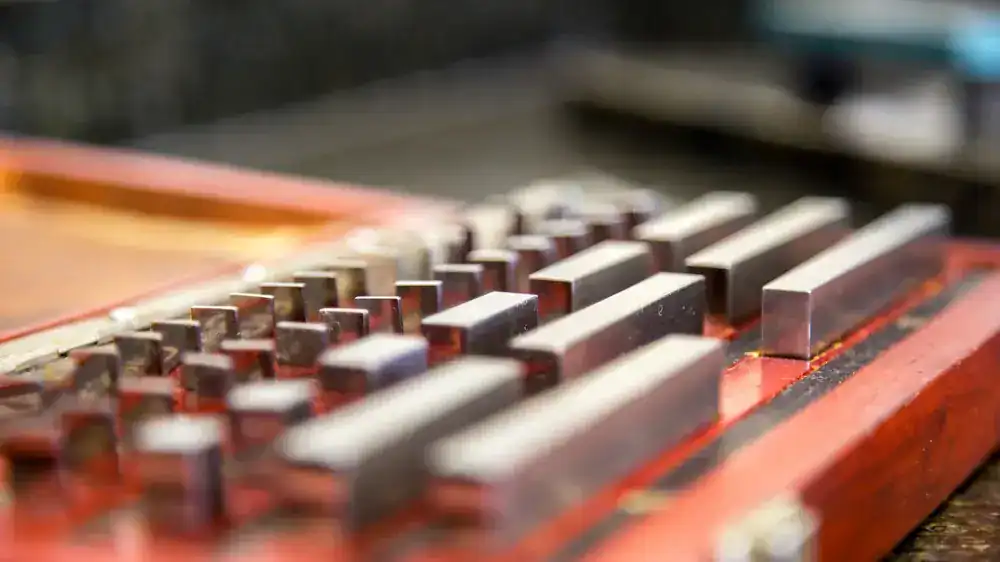
Obtain a Calibration Standard
Use a calibration standard that can be traceable to a national standard such as a precision ground bar, a master gage block, or a gage block.
Clean the Caliper
Clean the caliper with a clean, dry cloth to remove any dirt or debris that may affect the accuracy of the calibration.
Adjust the Caliper’s Zero Point
Check the caliper’s zero point and adjust it, if necessary, by using the adjustment screws or knobs. This will ensure that the caliper is measuring correctly from the start.
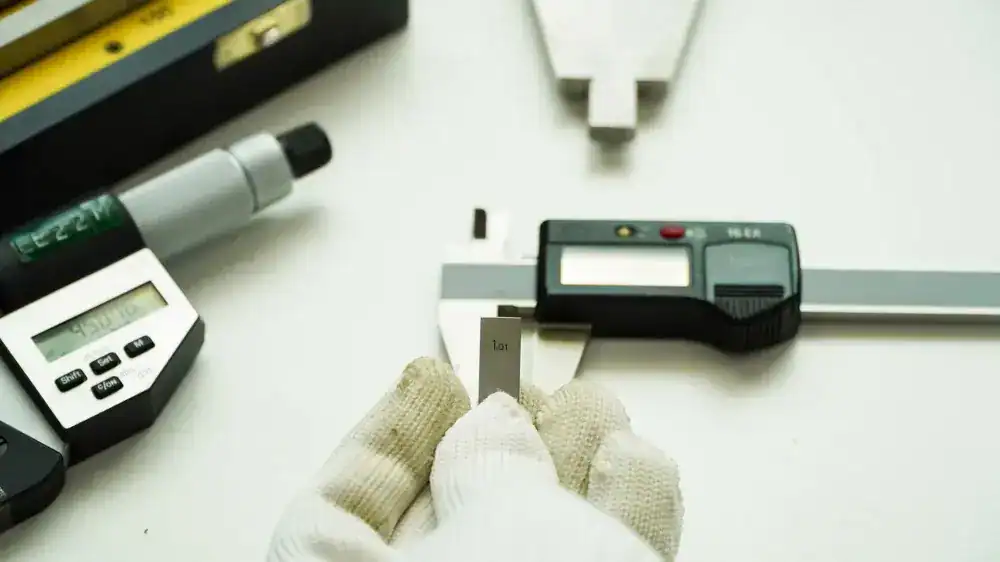
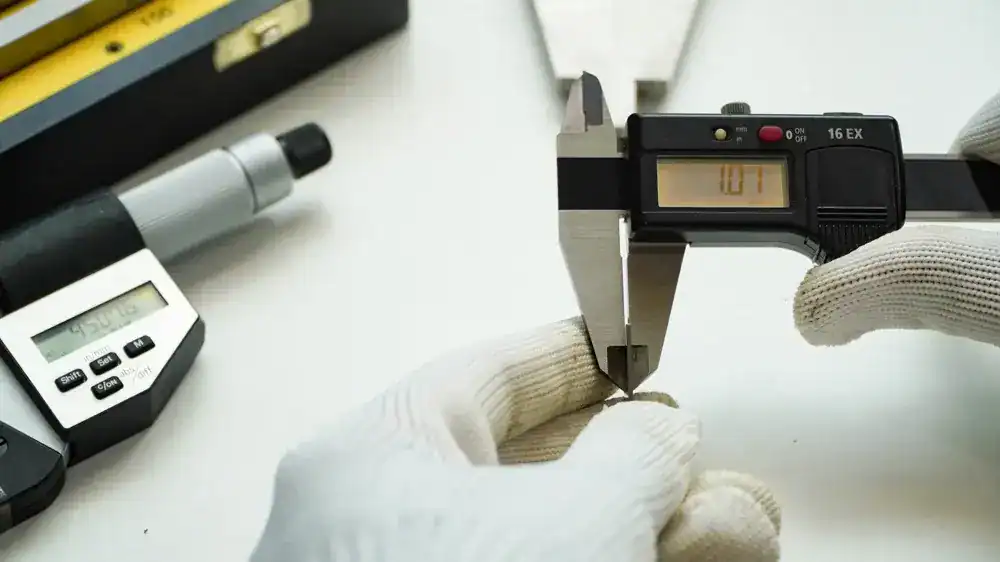
Measure the Calibration Standard
Use the caliper to measure the calibration standard and compare the measurement to the known value of the standard that you are using. A good rule of thumb is to have at least three testing points across the measuring range. Typically this is low, medium, and high.
Adjust the Caliper if Necessary
If the measurement is outside of the manufacturer’s specified tolerances, adjust the caliper by using the adjustment screws or knobs.
Repeat the Process
Repeat the measuring and adjusting process until the caliper is measuring within the manufacturer’s specified tolerances.
Document the Calibration
Once the caliper is calibrated, document the date, the person who performed the calibration, the method used, and the results.
It’s important to note that the process and steps of calibrating a caliper may vary depending on the type of caliper and the manufacturer’s instructions. It’s recommended to always consult the caliper’s instruction manual for specific details and instructions.
It’s also important to note that it’s recommended to calibrate a caliper by a professional or by someone who has been trained and has the knowledge and equipment to do so, to ensure accuracy and compliance with industry standards. If you have any doubt about your calibration procedure and standards, consult a calibration laboratory like Fox Valley Metrology.
Managing Calibration Records And Labels
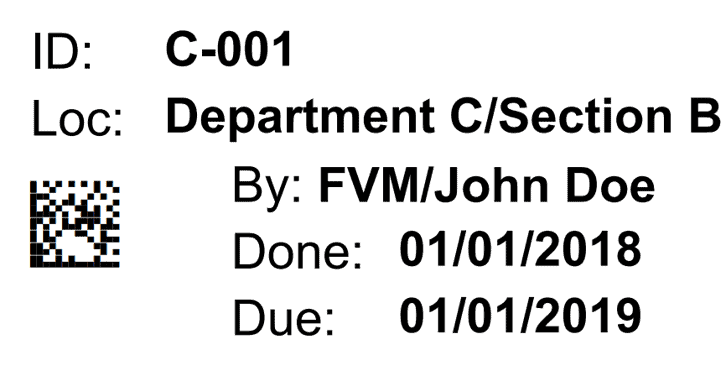
What Should Go On Your Calibration Label
Calibration labels are required to ensure that equipment and instruments are performing within their specified accuracy and measurement range. When equipment is calibrated, it is adjusted and tested against a known standard to ensure that it is providing accurate and reliable measurements. A calibration label provides a record of when the calibration was performed, when the next calibration is due, and the results of the calibration.
Having calibration labels on equipment also helps ensure that the equipment is being used and maintained properly. For example, if an equipment is found to be out of calibration, it can be taken out of service and recalibrated before it is used again. This helps ensure that the equipment is providing accurate and reliable measurements, which is important for many industries such as healthcare, manufacturing, and scientific research where precision is crucial.
In addition, calibration labels are also required by many regulatory agencies such as FDA, ISO, OSHA and many others to comply with industry standards and regulations. This can be a requirement for quality control and compliance purposes, as well as ensuring that equipment is safe to use and that the measurements it provides can be trusted.
A calibration label for a piece of equipment or instrument typically includes the following information:
- The identification number or serial number of the equipment that was calibrated
- The date the calibration was performed
- The date the calibration is due or the interval at which the equipment should be recalibrated
Other information that could be useful on the calibration label include:
- The measurement standards or equipment used to perform the calibration
- The name and/or signature of the technician who performed the calibration
- The calibration results or measurements that were taken
- Any notes or comments regarding the calibration
Maintaining Your Caliper Calibration Data Records
Maintaining a calibration database of equipment is important because it allows for the tracking of the performance and accuracy of the equipment over time. This can be used to identify when equipment needs to be serviced or replaced, as well as to ensure that the equipment is providing accurate and reliable results. Additionally, a calibration database can be used for regulatory compliance, such as for quality control in manufacturing or for meeting industry standards.
All of the data that was collected as a part of the certificate creation process should be stored as discrete fields for each record.
Conclusion
Caliper calibration is far more than a routine maintenance task, it is a critical part of ensuring measurement accuracy, product quality, and compliance with industry standards. By regularly calibrating your calipers, preparing both the tool and the environment correctly, and working with a trusted accredited laboratory, you can minimize measurement uncertainty and extend the life of your equipment.
Whether you perform in-house verification or outsource to a professional calibration provider, maintaining accurate, traceable calibration records ensures consistency and confidence across your quality system. Ultimately, a well-calibrated caliper doesn’t just support reliable measurements, it safeguards your entire manufacturing process from costly errors and rework.
If you’re ready to take the guesswork out of caliper calibration, partner with a calibration lab that’s accredited, experienced, and equipped to meet your needs with precision and care.
Caliper Calibration FAQs
Q1. Can I calibrate my caliper myself?
Yes you can calibrate your caliper yourself, but if you need your caliper for professional standards, you will need a professional calibration lab to calibrate your calibrate to ensure traceability and compliance with standards.
Q2. Why are calibration records important?
Maintaining records ensures traceability, supports audits, and verifies your tools meet ISO quality requirements.
Q3. How often should a caliper be calibrated?
A good rule of thumb is to calibrate your caliper at least once a year. Calipers that are used for critical measurements or in a harsh condition may require calibration every few months.
Q4. What information appears on a calibration label?
Calibration labels shows the date the calibration was completed, the next calibration due date, serial number, and technician or lab performing the calibration.
The Definitive Guide To Calipers
What’s Next: What Is The Future Of Calipers?
At this point, we have covered nearly everything there is to know about calipers… for now…
In the next and final section in this series, we will dive into the possible future of calipers and what we could see in technological advancements for the tool. Lets get started and head to Section 14: The Future of Calipers.
In the next and final section in this series, we will dive into the possible future of calipers and what we could see in technological advancements for the tool. Let’s get started and head to Section 14: The Future of Calipers.
ISO/IEC 17025 Accredited Caliper Calibration
Fox Valley Metrology offers precise caliper calibration for any make or model. Our ISO/IEC 17025 accreditation guarantees testing to the highest industry standards. We offer fast, reliable in-lab or onsite calibration services to fit your needs and schedule.
- ✓ ISO/IEC 17025 accredited calibration vendor
- ✓ Broadest calibration scope in the industry
- ✓ 3-5 day turnaround time in-lab calibrations
- ✓ Pickup and delivery service options
- ✓ Onsite calibration available