


How Accurate Is Your Caliper And Why Does That Matter?
Caliper accuracy describes how close a measurement is to the true size of a part, with most standard calipers offering an accuracy of ±0.001 inches (±0.02 mm). The accuracy on a caliper matters because inaccurate measurements can lead to rejected parts, rework, or product failure. Knowing your caliper’s accuracy helps determine whether it’s suitable for a specific tolerance, ensures confidence in measurement results, and reduces the risk of passing or failing parts incorrectly.
A caliper is one of the most commonly used measuring tools in manufacturing, machining, quality control, and inspection. They are versatile, easy to use, and can take numerous measurements all with a single tool.
But here’s the catch: a caliper is only useful if it is accurate.
Whether you are checking part dimensions on the shop floor or verifying tolerances in a quality lab, an inaccurate measurement with your caliper can lead to rejected parts, rework, or even product failures.
In this article we will break down what caliper accuracy really means, why it matters, how to test to see if your caliper is accurate and what factors can affect the accuracy of your caliper overtime.
In This Article:
- Defining the Accuracy of a Caliper
- Why is Knowing The Accuracy of a Caliper Important?
- Selecting a Caliper With the Correct Accuracy
- Factors that Affect Caliper Accuracy
- Caliper Accuracy FAQs
This is the seventh article in our series, The Definitive Guide to Calipers.
If you missed the last part of the series: The Anatomy of a Caliper, check it out now!
Defining The Accuracy Of A Caliper
When you are learning how to use a caliper for the first time or even when you are a seasoned veteran caliper user, one of the most important concepts to understand is the accuracy of your caliper. Simply put, caliper accuracy is defined as how close a measurement is taken with a caliper is to the true, actual size of the part being measured. While that may sound straight forward it is one of the most important concepts to understand as accuracy helps set a realistic expectation and builds confidence in your measurements.
Accuracy vs. Resolution vs. Repeatability
Before we dive deeper into the accuracy of a caliper, there are a couple of definitions that we need to define that commonly get confused with one another. These terms are essential in understanding how a caliper performs.
Accuracy which we have already briefly mentioned, refers to how close a measurement is to the true or accepted value of a part that is being measured. In other words, accuracy will tell you whether the number you are reading from your measurement is reliable and trustworthy. The easiest way to think of accuracy is to think of a target. The “true value” of the target is the center bullseye. The “measured values” would be like graphing where all your arrows hit around that bullseye. The accuracy of your shot is how far those arrows are hitting from the bullseye.
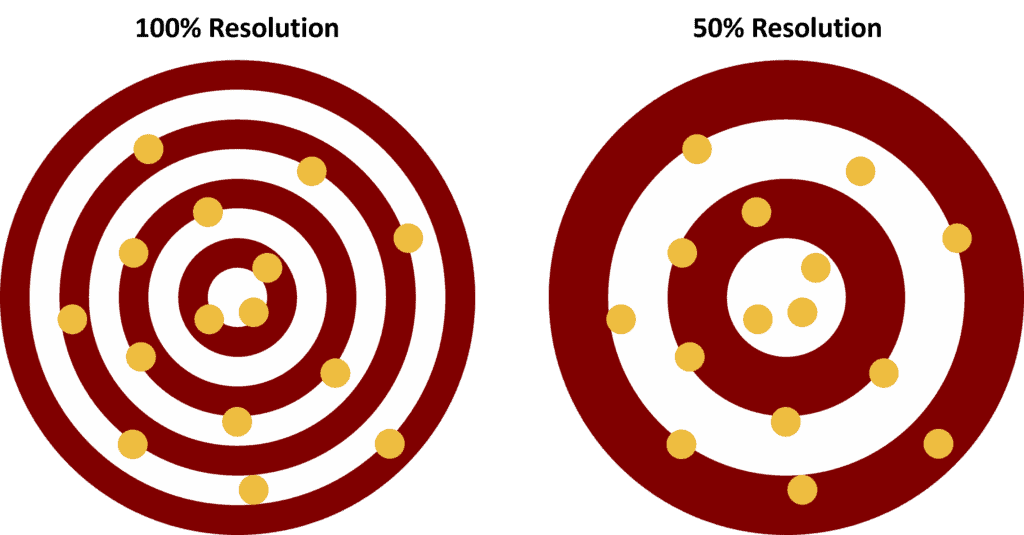
Resolution is referred to the smallest increment or step size that the caliper can display. It determines the level of detail or granularity in the measurements it provides. In simpler terms, it is the number of digits or counts that the caliper can show. To help understand it more, we can revisit the target example. The image on the left represents a caliper with “full” resolution, while the one on the right has half the resolution of the other. If you look at each circle as a “bucket”, the measurements have twice as many buckets to fall into on the image with a higher resolution.
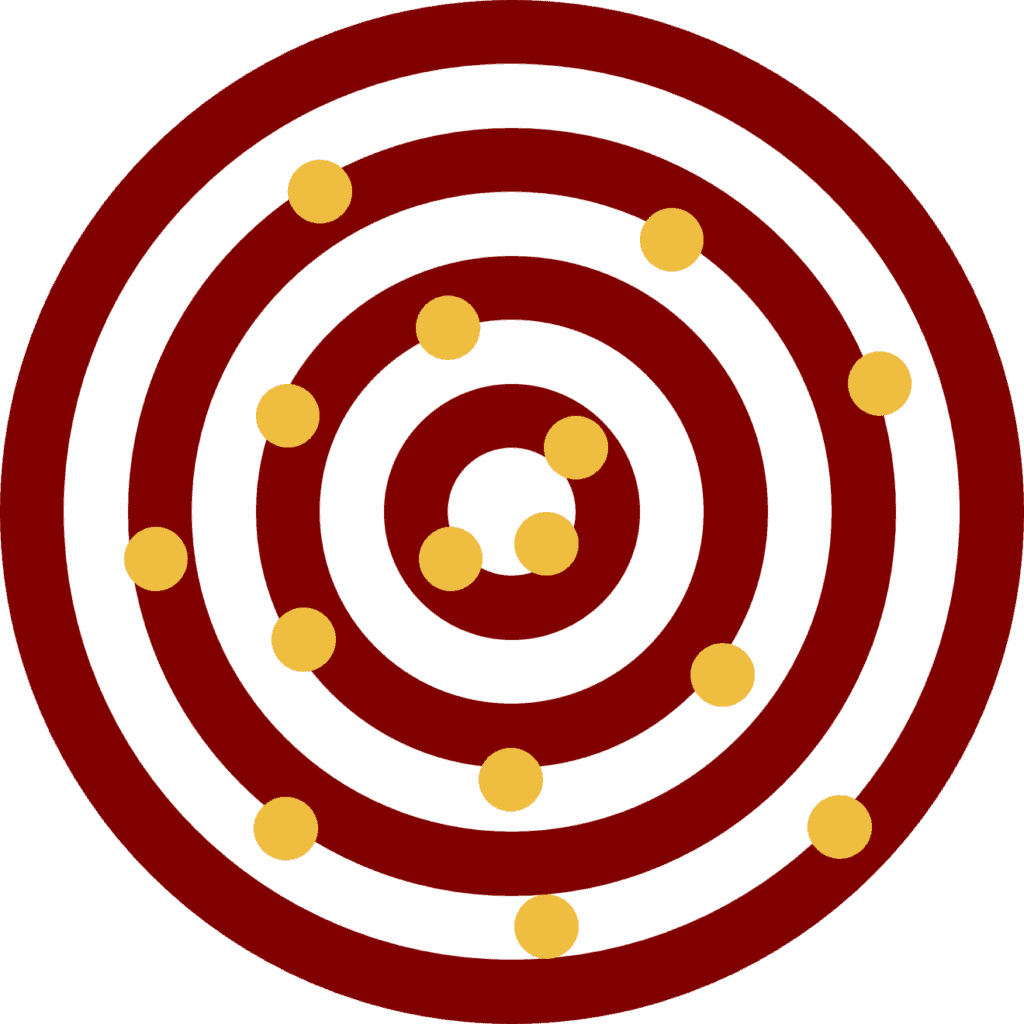
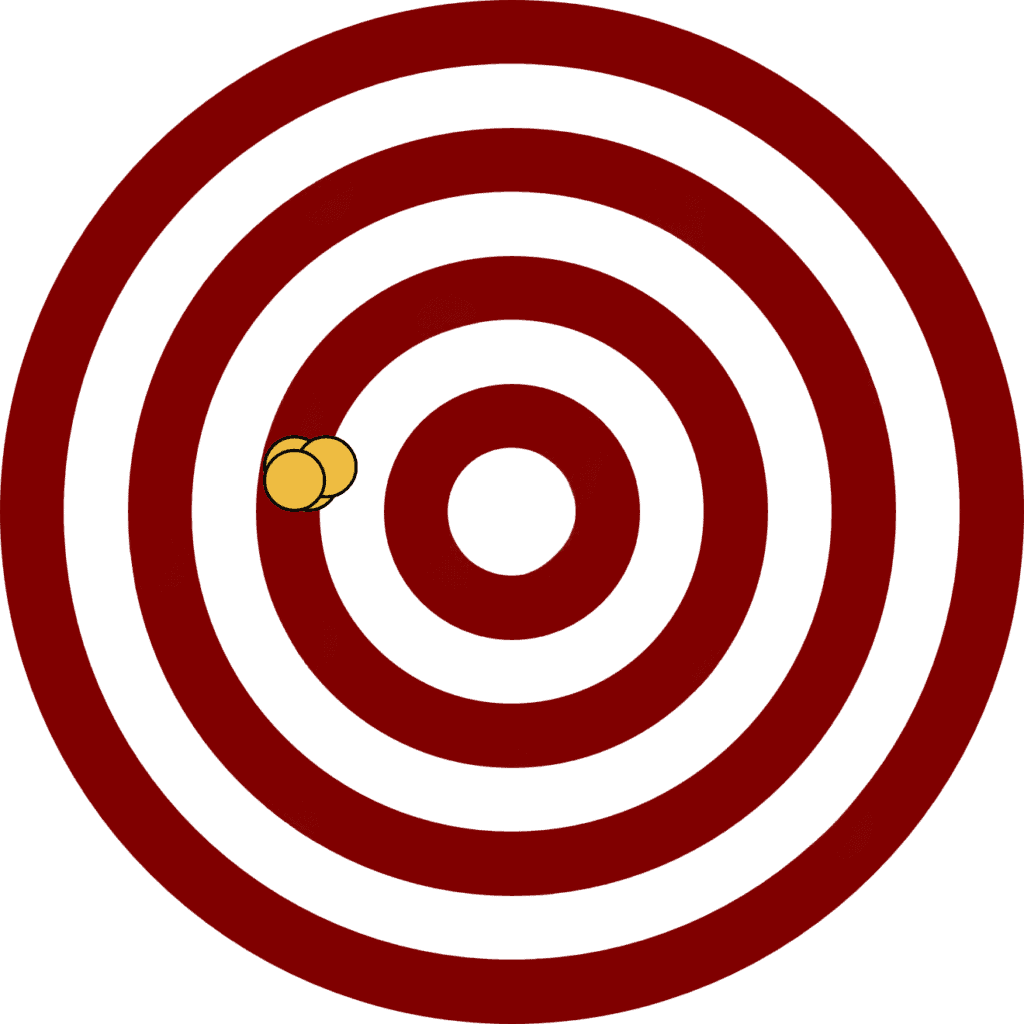
Repeatability is the caliper’s ability to produce the same measurement over and over again when measuring the same object multiple times in the same conditions. This term can easily be confused with accuracy as one may think that they are accurate by getting the same measurement over and over again, but that can be far from the case. Keep in mind that accuracy is defined as how close a measurement is to the true value of the part being measured. This could mean that you could be getting repeatable measurements, but you could be far away from the true value. We can visualize this more again with the target example. As you can see that the dots are all around the same place on the target, but they are far from the bullseye which would be the true value.
Typical Accuracy of Calipers
Most standard calipers, whether you are using a vernier, dial, or digital, offer an accuracy of ±0.001 inches (±0.02 mm). What this means is that the measurement you see on the display of your caliper could be off by up to one thousandth of an inch (or two hundredths of a millimeter) from the part’s true size. In practical terms, if a part is exactly 1.000 inches wide, a caliper with an accuracy of ±0.001 inches might show a reading anywhere between 0.999 inches and 1.001 inches, even when it is used correctly. This small ranger is often considered an normal and acceptable for a caliper.
Keep in mind that cheaper calipers will often have a lower accuracy range so it is important to know that level of accuracy you are looking for before purchasing a caliper. The same goes for more expensive calipers, they will have an even tighter range of accuracy.
Why Is Knowing The Accuracy Of A Caliper Important?
Knowing the accuracy of your caliper is just as important as knowing how to complete and read a measurement. Accuracy will tall you what level of confidence you can have in the measurement you are taking and will ultimately help you decide whether a caliper is the right tool for the job. When you know the accuracy of your caliper, you are able to interpret measurements correctly, make better decisions about part acceptance, and avoid unnecessary rework or scrap.
When dealing with the accuracy of a caliper there will be a number of factors where a caliper will always have a certain level of uncertainty in the measuring it provides.
The uncertainty of a measurement is the probability that the reading of the measurement you are taking is true. Because of this, having a higher ratio between your caliper’s accuracy compared the fluctuation of the source will give you a higher likelihood that the measurement you just took is true.
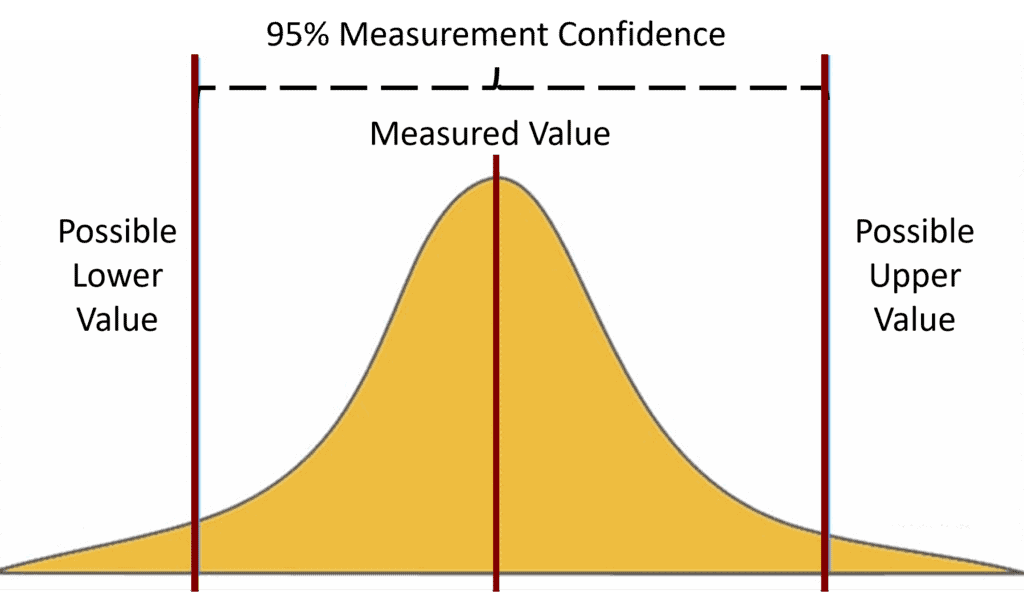
When selecting a caliper for the measurement, the standard rule-of-thumb is a caliper should be 4 times more accurate than the tolerance of the measurement you are performing, while 10 times more accurate is preferred. This is known as the Test Uncertainty Ratio (TUR). If the 4x rule is used, you can trust (within a 95% confidence level) that the measured value will be precise enough to confirm that the measurement you are taking is in tolerance.
The chart below shows what this looks like when comparing the measurement tolerance to the uncertainty ratios, when the measurement is theoretically at the nominal.
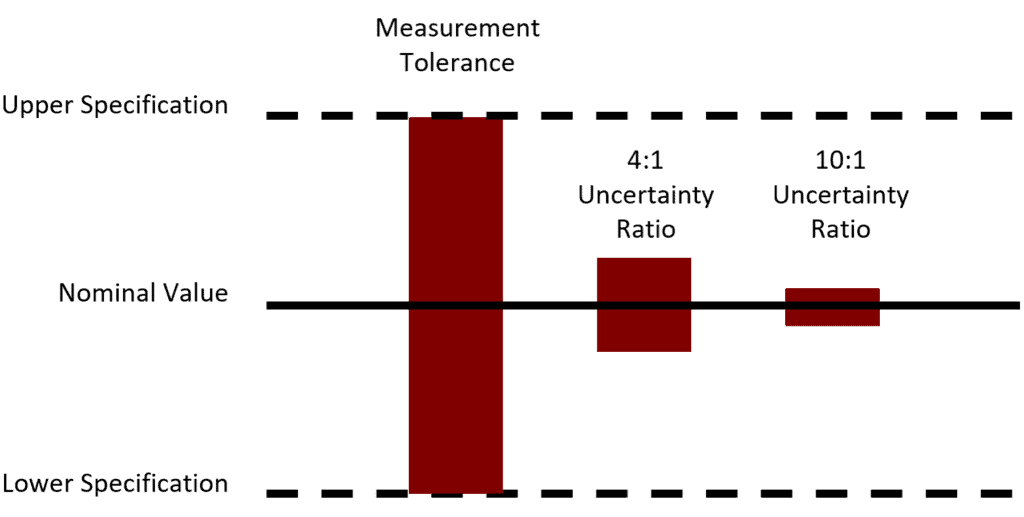
The second bar of the above chart represents a caliper that has a 4:1 uncertainty ratio, while the third bar represents a caliper that has a 10:1 uncertainty ratio. The height of the two bars represents the possible values the measurement you just performed could actually be.
Let’s say your measurement was X. When you bring the accuracy of the caliper into consideration, what you are really saying is, “The measurement was X ±Y” – where Y is the uncertainty of the measurement. As you can see, the caliper with a 10:1 uncertainty ratio gives is far more accurate and gives you much more confidence in the measurement you have just taken.
Most commonly though, the measurement that you take does not come in exactly at the nominal of what you are measuring. Let’s pretend the measurement you take comes about halfway between the nominal value and its acceptable upper limit. The chart then would look something like this.

In this case, the measured value is far enough away from its upper limit that both of the calipers will give you a passing measurement. You can be confident that the measured value is truly well within its acceptable tolerance. However, if the measured value is far closer to its upper limit, we start to run into issues. This is shown in the chart below.

In the case of the 10:1 uncertainty ratio caliper, you can see that even though we are approaching the upper limit of the tolerance of the measurement you are taking, we are still within tolerance. However, when looking mat the 4:1 uncertainty ratio caliper, the confidence band of the measurement has gone above the upper limit. This, unfortunately, means that you could wind up failing a measurement – causing higher costs to redo the work. On the flip side of this, you could accidentally pass a measurement that is actually above its tolerance limit – causing potential safety issues.
Selecting A Caliper With The Correct Accuracy
Let’s bring it back to the real world after getting a little “deep in the weeds” and consider a more common situation that involves accuracy with your caliper and how to select the right caliper with the correct accuracy. Take for example measuring the diameter of a bolt or a shift to make sure it fits into a hole or linking part. As we stated before, general fit measurements often allow a tolerance of ±0.001in or more.
If the sole purpose of using the caliper is to measure a dimension like that, you would use the test uncertainty ratio (TUR) to decide which caliper could do that job, If a 4:1 ratio is good enough for you, then a caliper with a measurement accuracy of ±0.0025in would be acceptable. Anything with an accuracy better than that would also meet the requirement.
However, there are applications that require a much more precise measurement such as measuring a component such as a precision shift or bushing. These tolerances given will be much tighter. An incorrectly sized part could lead to poor fit, excessive wear, or assembly failure. This specification of the part may only also a variance of ±0.001in. As a result you will need to be far more accurate in your measurement and a caliper may not be the correct tool for this job. You may need to turn to a more accurate measurement tool such as a micrometer with an accuracy in the area of ±0.0001in.
Factors That Affect Caliper Accuracy
Even the highest quality caliper can still produce inaccurate measuring if certain factors aren’t taken into account. The accuracy of a caliper isn’t determined by the tool itself, but it is also influenced by how the caliper is handled, the condition it is in, and the environment in which it is used.
Tool Wear and Mechanical Damage
Overtime the repeated use of a caliper can take a toll on the instrument, especially if it is used frequently or handled roughly. Some common signs of wear on your caliper could include worn or rounded measuring jaws, loose or gritty slider movement, and internal gear wear on the caliper. All of these factors can introduce the smallest measurement errors. Small amounts of wear can prevent the jaws from making proper contact with part which will produce slightly inaccurate readings. These issues are not always obvious at first either. A caliper may still look fine and move smoothly, but they may be measuring inaccurately. Regular inspection, gentle handing, and avoiding drops and heavy impact will go a long way in preserving the accuracy of your caliper.
Operator Technique
The accuracy of your measurement also depends on how the caliper is used, especially for beginners who are still developing good measuring habits. Applying excessive measuring force can flex the jaws of the caliper or compress the part being measuring which would result in a measurement that’s smaller than its true size. Measuring at an angle instead of square to the part can also skew your measurement since the jaws are no longer contacting the surface correctly. All of these mistake can reduce repeatability and accuracy, making it difficult to trust your readings. Developing proper technique while using your caliper will make a big difference in accuracy and help produce reliable, repeatable measurements.
Environmental Conditions
One other factor that can have a noticeable impact of the accuracy of your caliper is the external environmental conditions that it is in. Temperature changes are one of the biggest factors. Changes in temperature can affect the caliper and the part being measured by expanding or contracting when the temperature rises or falls. Even small differences in temperature can introduce measurement errors. Dirt, oil, and debris on the measuring surface or the jaws of the caliper can prevent proper contact and lead to reading that are slightly off without being obvious to the user. Humidity and corrosion also plays an external part of the accuracy of your caliper. It is always good to have clean tools, stable temperatures, and a controlled measuring environment when using your caliper so that it stays accurate and produces trustworthy measurements.
Calibration Interval
A caliper that was accurate last year, or even last month, may not be accurate today. This can be prevented by regular calibration. Calibration ensures that your measurements remain traceable to recognized standards and that your caliper delivers the level of accuracy it was designed for. For organizations that follow quality standards, such as ISO 9100, calibration is not just a best practice but rather a requirement to demonstrate compliance and so that they maintain confidence in measurement results.
Conclusion
Caliper accuracy isn’t just a technical detail that you can skim over, it is the foundation of reliable and consistent measurements. Understanding what accuracy is and why it is important, how to select the correct caliper for your accuracy measurements, and what factors affect accuracy will help you get the most out of one of the most useful tools in your toolbox.
Caliper Accuracy FAQs
Q1. How accurate are digital calipers?
Most digital calipers are accurate to ±0.001″ when properly calibrated and used correctly.
Q2. What is the difference between accuracy and resolution?
Accuracy describes how close a measurement is to the true value where resolution is teh smallest increment that caliper can display (e.g., 0.001in).
Q3. What is a test uncertainty ratio (TUR), and why does it matter?
TUR is the ratio of the part’s tolerance to the measurement uncertainty. A higher TUR (typically 4:1 or greater) ensures the caliper is accurate enough to make reliable measurements.
Q4. Does the type of caliper affect accuracy?
The type itself does not affect accuracy, but can affect the ease of use and readability. Accuracy largely depends on tool quality, calibration, and condition, rather than type alone.
The Definitive Guide To Calipers
What’s Next: What Features And Accessories Should I Look For In A Caliper?
Now that you have a basic understanding of accuracy and why it matters, the next step in learning about calipers is to explore the different features and accessories.
In the next post, we will go over the different features and accessories that can be part of a calipers. Let’s head to Section 8: Caliper Features and Accessories.
In the next post, we will go over the different features and accessories that can be part of a calipers. Let’s head to Section 8: Caliper Features and Accessories.
ISO/IEC 17025 Accredited Caliper Calibration
Fox Valley Metrology offers precise caliper calibration for any make or model. Our ISO/IEC 17025 accreditation guarantees testing to the highest industry standards. We offer fast, reliable in-lab or onsite calibration services to fit your needs and schedule.
- ✓ ISO/IEC 17025 accredited calibration vendor
- ✓ Broadest calibration scope in the industry
- ✓ 3-5 day turnaround time in-lab calibrations
- ✓ Pickup and delivery service options
- ✓ Onsite calibration available