


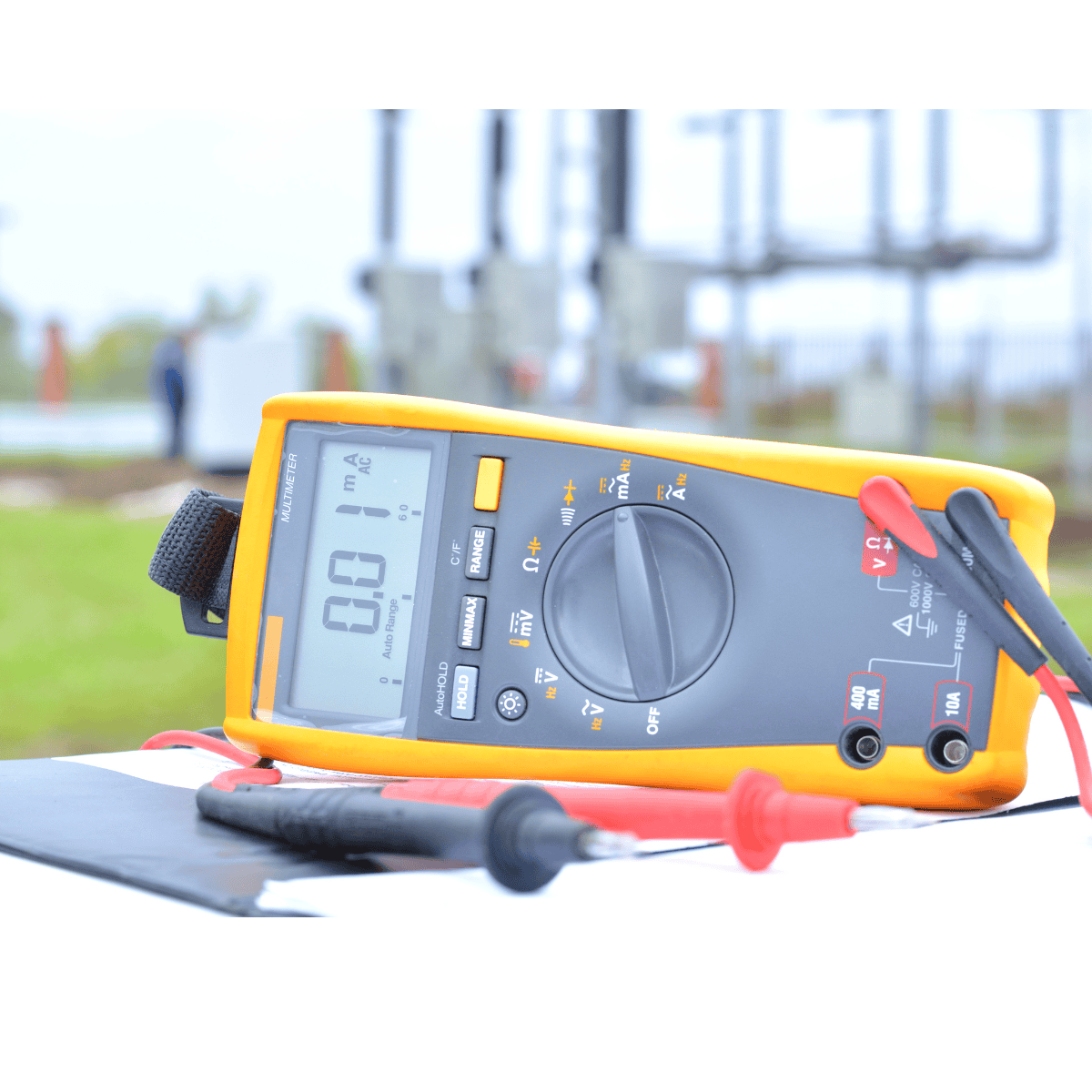
What Is An Analog Multimeter?

An analog multimeter is a simple measuring device for basic electrical parameters (such as voltage, current and resistance) which contains a dial with numbers and a needle that moves to show measurements.
An analog multimeter is the “old faithful” of the electrical measurement world. While it may not be the flashiest instrument on the planet, it is certainly a workhorse. It can tell you things like how much voltage is in a circuit or how much resistance is in a wire. You just need to connect the right wires to the right places and read the number where the needle points.
It’s a basic, easy-to-use gadget that helps you understand and measure electricity without any fancy digital stuff. Sort of like a tape measure versus a laser distance meter – you know that it will just work.
This article discusses the analog multimeter and its relative strengths and weaknesses.
In This Article:
- Analog Multimeter Components
- How Does an Analog Multimeter Work?
- Why Use Analog Multimeters Today?
- Analog Multimeter FAQs
This is the fourth article in our series, The Definitive Guide to Multimeters.
If you missed the last part of the series: What Does a Multimeter Measure? check it out now! You will be able to work your way back to this article quite quickly.
Key Components Of Analog Multimeters
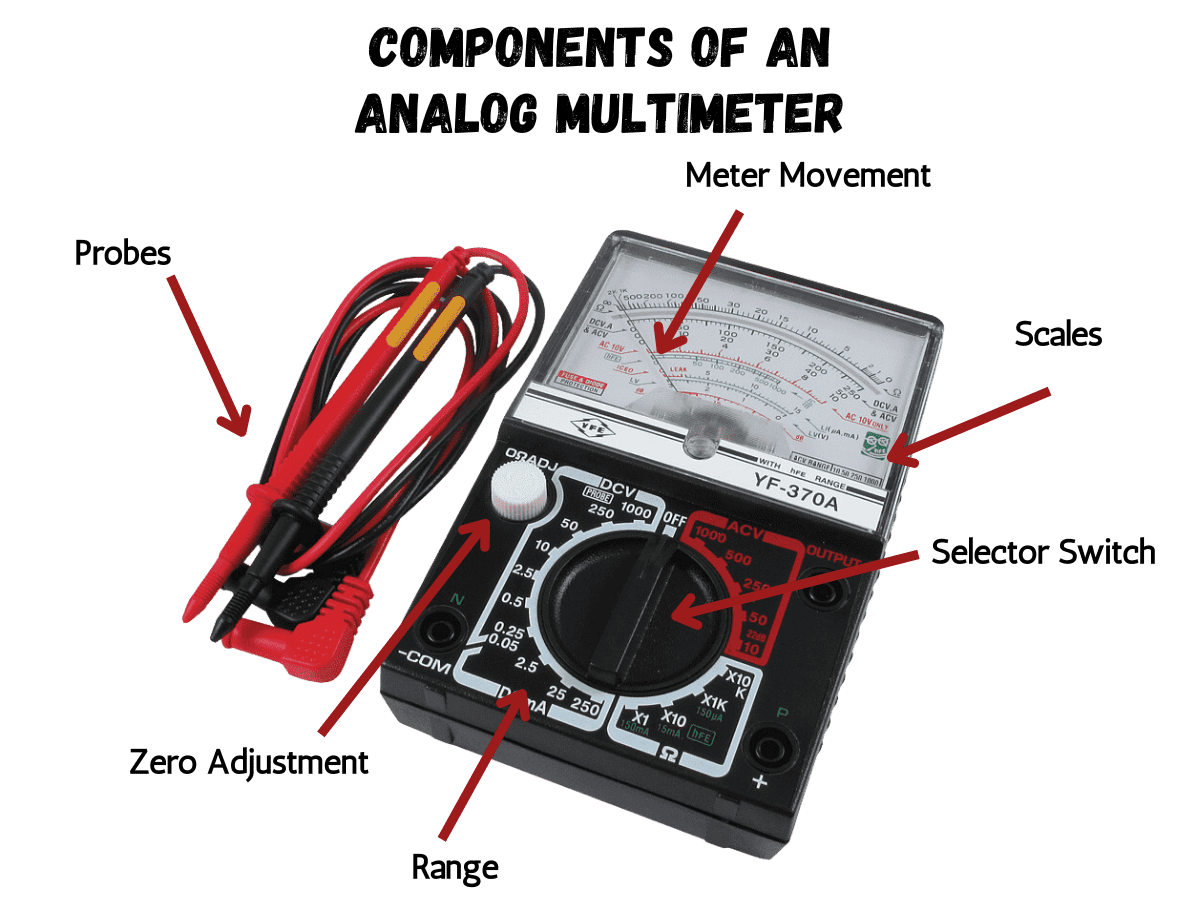
The basic components of an analog multimeter include:
- Meter Movement
- Selector Switch
- Range Switch
- Scales
- Zero Adjustment
- Probes
Meter Movement
The heart of an analog multimeter is the meter movement. It is a mechanical device that consists of a coil of wire, a needle, and a spring. The coil generates a magnetic field when a current flows through it, and the needle moves in response to this magnetic field. The position of the needle indicates the measured value on a scale.
Selector Switch
Analog multimeters have a selector switch that allows you to choose the desired measurement function. The switch typically has positions for voltage (AC and DC), current (AC and DC), and resistance. Some analog multimeters also have additional functions like continuity and diode testing.
Range Switch
Analog multimeters often include a range switch that lets you select the appropriate measurement range for the quantity you want to measure. The range switch adjusts the sensitivity of the meter movement to ensure accurate readings. The available ranges vary depending on the specific multimeter model.
Scales
Analog multimeters have printed scales on the face of the instrument. These scales provide the visual representation of the measured values. Each measurement function (voltage, current, resistance) has its own dedicated scale with markings for different ranges and units.
Zero Adjustment
Analog multimeters often include a zero-adjustment screw or knob. This allows you to calibrate the meter movement to compensate for any deviation or misalignment of the needle at zero when no current is flowing, or no voltage is present.
Probes
Analog multimeters come with detachable probes for making electrical connections. The probes typically consist of a red (positive) and a black (negative) lead with metal tips. The metal tips can be used to touch the circuit points or components being measured. You can also get alligator clips to make testing easier by not having to hold the probes at all times to the circuit you are testing.
How Does An Analog Multimeter Work?
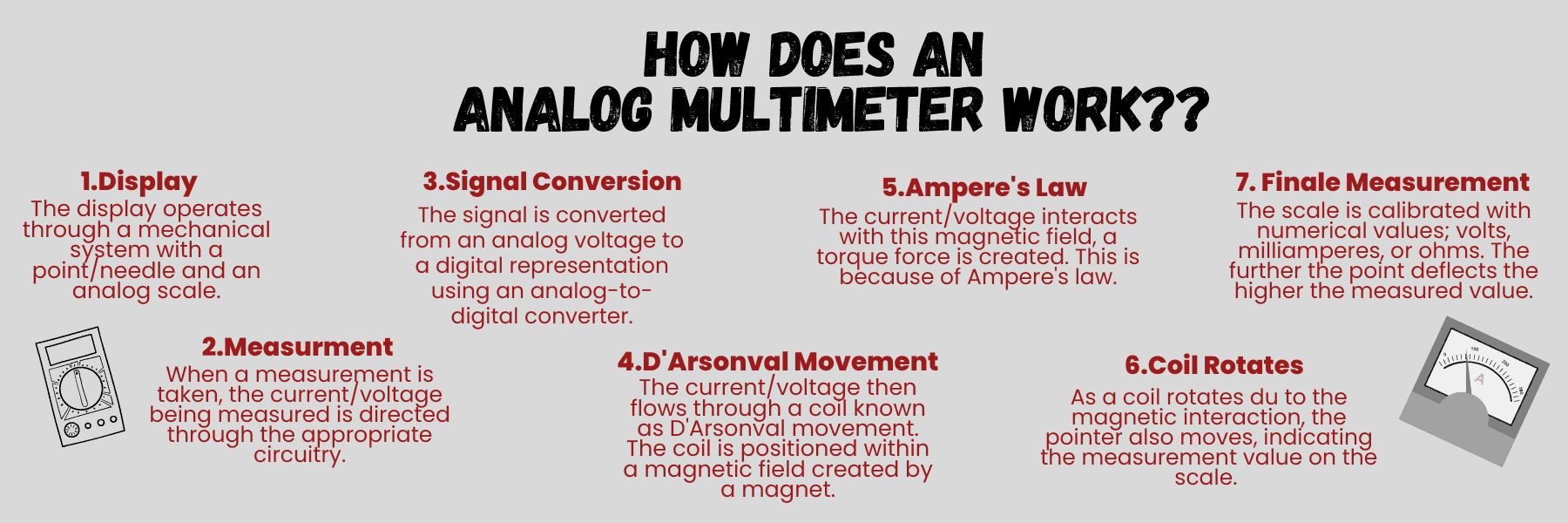
The display on an analog multimeter operates through a mechanical system consisting of a pointer or needle and an analog scale.
When a measurement is taken, the current or voltage being measured is directed through the appropriate circuitry within the multimeter.
This current or voltage then flows through a coil of wire known as a D’Arsonval movement. This coil is positioned within a magnetic field created by a permanent magnet.
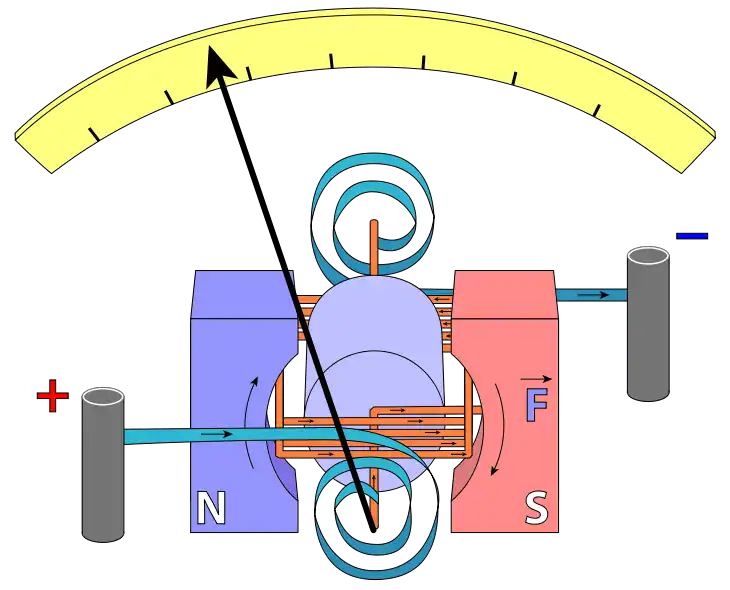
As the current or voltage interacts with this magnetic field, a torque force is created. This is because of Ampere’s law:
“The magnetic field created by an electric current is proportional to the size of that electric current with a constant of proportionality equal to the permeability of free space.”
– Andre Marie Ampere, 1820
Attached to the coil is a pointer or needle. As the coil rotates due to the magnetic interaction, the pointer also moves, indicating the measurement value on the scale.
The scale is calibrated with numerical values and units corresponding to the specific measurement being taken, such as volts (V), milliamperes (mA), or ohms (Ω). The farther the pointer deflects, the higher the measured value. The position of the pointer provides a visual representation of the magnitude of the measured quantity.
Why Use Analog Multimeters Today?
Despite digital multimeters’ dominance, analog models have unique advantages:
- Durability: No reliance on batteries for basic measurements, ideal for harsh environments.
- Visual Feedback: Needle movement shows trends (e.g., fluctuating voltage) better than digital readouts.
- Niche Uses: Perfect for restoring vintage electronics (e.g., tube radios) or teaching Ohm’s Law in schools.
An analog multimeter still has its limitations such as a lower accuracy (typically ±2%), parallax errors when reading scales, and fewer features like capacitance or frequency measurement. Since analog multimeters typically have a lower accuracy it is best to periodically verify and calibrate the multimeter so that it remains within acceptable tolerances.
Conclusion
While digital multimeters may be more common today, analog multimeters remain valuable tools for technicians, educators, and hobbyists who appreciate their simplicity, durability, and visual feedback. Understanding their components and operation not only helps you use them effectively but also deepens your grasp of fundamental electrical measurement principles.
Analog Multimeter FAQs
Q1. Are analog multimeters still used today?
Yes, analog multimeters are still used for vintage repairs, education, and environments where batter-free operation is key.
Q2. How accurate are analog multimeters?
Analog multimeters typically have an accuracy of ±2%, less precise than digital models (±0.5% or better).
Q3. Can analog multimeters measure AC and DC?
Yes, there are separate settings for AC/DC voltage and current.
Q4. Why should I choose an analog multimeter over a digital multimeter?
Analog multimeters have more durability, visual trend tracking, and works better on older equipment.
The Definitive Guide To Multimeters
What’s Next: What Is A Digital Multimeter?
Now that we have explored the world of analog multimeters, let’s look into the natural evolution of multimeters from analog to digital.
In the next section, we will dive into Digital Multimeters. Let’s get started and head to Section 5: Digital Multimeters.
ISO/IEC 17025 Accredited Multimeter Calibration
Fox Valley Metrology offers precise multimeter calibration for any make or model. Our ISO/IEC 17025 accreditation guarantees testing to the highest industry standards. We offer fast, reliable in-lab or onsite calibration services to fit your needs and schedule.
- ✓ ISO/IEC 17025 accredited calibration vendor
- ✓ Broadest calibration scope in the industry
- ✓ 3-5 day turnaround time in-lab calibrations
- ✓ Pickup and delivery service options
- ✓ Onsite calibration available